

Over the past few weeks, I have been trying to find a direction for the Via Ciceronis. However, whenever I set out to write, I found myself needing to turn back. Either I jumped to a destination so that there was no path to follow, or I got lost in a forest of details next to the path and got nowhere. After circling back to the beginning a few times, I decided to sit still. Where is the Via Ciceronis going? It must be going somewhere. The conclusion that I have come to is that the Via Ciceronis will lead to a vantage point from which we will be able to see ourselves and the world around us more clearly and the steps we shall use to get there are words packed full of meaning.
Words form the building blocks of our language. They contain meaning and when joined together they can transform into amazing structures. It is through words that we find meaning as human beings. In fact, without them, we would scarcely be human. However, language is not a fixed thing, and the meanings of words can change. In the early 4th Century BC, the great Greek historian Thucydides noticed that a social crisis like civil war changed how words were used.
“Men reversed the usual evaluative force of words to suit their own assessment of actions.” (Thuc. 3.84)
In this way, language changes from a tool expressing true meaning, to one that expresses a fictional meaning. Thucydides uses the example of ‘bravery’ being used to describe a reckless action to show how inappropriate actions could be justified by covering them in decorative words. Of course, the words definition does not change. Bravery still means bravery. However, because it is now being used as a pretty word to cover up and justify inappropriate actions, its value as a word expressing true meaning is lost. We can see evidence of this devolution of language in our own time as well. For example, the term Democracy still means ‘rule by the people’. However, the word has become a pretty word used in political rhetoric to paint someone or something as good. “What makes Country X so good? Well, it’s a democracy!” But what does this really mean? Is this an Athenian Democracy? a direct Democracy? a representative Democracy? There are many different types of democracy; some of them are good, and others are bad. Therefore, this word does not really tell us anything meaningful about country X and it certainly does not give us enough information to make a moral judgement. Instead, with no argument based on truth, it creates a fiction of Country X as good. The result is that it becomes very difficult to have an unbiased discussion on democracy as a political system honestly in public. The true meaning of the word has been lost in the fiction. This is how the meaning and value of a word can change. The effect that this has on society and individuals is quite dire and leaves many without any meaning at all.
The state of language was not entirely different in the lead up to the civil wars in the Late Republic. Oratory was a big part of political life in the Roman Republic. However, as the elite became more and more corrupt, oratory, as one might expect, became less about finding the true best way forward and more about telling a version of events that suited one’s own ‘assessment of actions’. The society had become sick as a response. During this crisis, Cicero began writing philosophy in Latin. This is significant because it went against the opinion held by practically everybody else at the time that philosophy was a subject to be discussed in Greek, that Latin just did not have the capacity to discuss philosophy appropriately. Latin was not a philosophical language. However, by discussing the Greek philosophy using Latin, Cicero wanted to enrich the Latin language and make it a philosophical language. He did this by creating what Gildenhard calls a ‘Paideia Romana’ (Using ‘paideia’ the Greek word for education and ‘Romana’ the Latin adjective). In his role as educator, I see Cicero as a ‘societal doctor’, finding the cure for a sick society in the enrichment of language through philosophy and practical ethics.
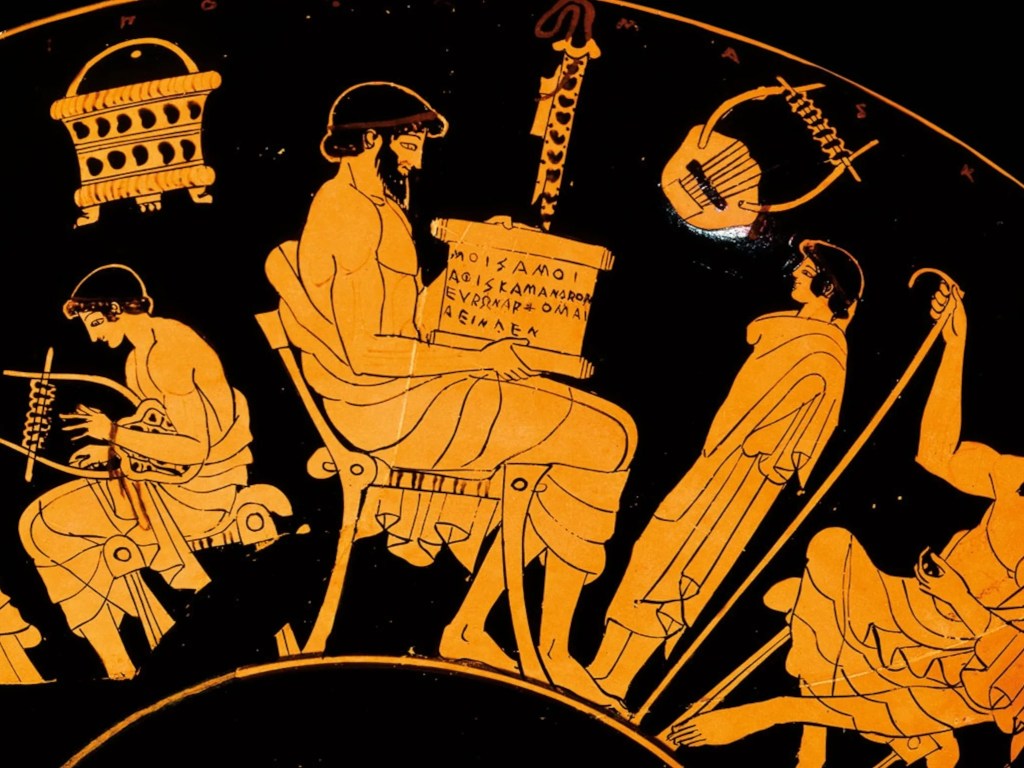
The philosophical framework that Cicero discusses in Latin encourages us to look at the political events of the Late Republic from a different perspective. It goes beyond the fictions of his time and allows us to view the social event as being driven by individual psychologies and their private passions. In the following posts, I would like to begin creating something of a ‘English Educatio’. We will discuss words in the Ciceronian vocabulary to open this philosophical framework to us. By discussing these Latin words in English, I hope to enrich our own language, and give more meaning to the English words that we use to translate them. Step by step, and word by word, we will approach our destination, a vantage point from which we will be able to look at the world from a different perspective and understand ourselves, our social communities, and the world around us better.

Bibliography
- Gildenhard, I., Paideia Romana, (Cambridge, 2007).
- Hammond, M. (trans.), Thucydides The Peloponnesian War, (Oxford , 2009).
- Lévy, C., “Cicero and the Creation of a Latin Philosophical Vocabulary”, in Atkins, J. W. and Bénaouïl, T., The Cambridge Companion to Cicero’s Philosophy, (Cambridge, 2022) 71-87.
 Via Ciceronis