

We have spent most of our journey analysing how the inward state (animus) functions. This understanding is fundamental for our journey and must act as a base camp from which to move forward. We do not live in a vacuum though. Nobody can survive life completely alone. From the moment we are born we are helpless and must rely on others. Even before we are born, we need our parents to copulate and our mothers to hold us in the womb for nine months. Social interaction is essential for the continuation of our species and being social is part of our human nature. However, the psychological experience gets lost in the social experience. We cannot see the beliefs, emotions, and feelings of other people, nor can others see ours. Nevertheless, the psychological does manifest itself outwardly in our words and actions. Up until this point, our gaze has been inwards. To go further, we need turn our gaze outwards. Therefore, I think it will be appropriate to begin our next leg of the journey with the Latin word virtus which is the source of all good and honourable speech and action.
We need to be cautious when looking for an English equivalent to the word virtus. ‘Virtue’ is one of the common translations, but this word is heavily coated in Christian ethics now. We must remember that Roman virtus came before Christianity and that it had nothing to do with our modern understanding of religious morality. Another option is ‘manliness’. Virtus stems from the word vir meaning ‘man’ which makes it much closer in meaning to ‘manliness’. However, this word brings to the fore the sensitive contemporary matter of gender. Although gender played a part, the connotations attached to the term vir are more about power than they are about gender. In the family, the vir was the person on whom people depended, the person who took responsibility for the safety and wellbeing of the others. In wider society, a vir was a man of independent means which allowed him to participate in politics freely and take responsibility for the safety and wellbeing of the wider community. In our own language, the word man was also used to refer to this positive aspect of power. We had phrases like “he’s the man of the house” which emphasised his position of power and responsibility over the family, not his role as a male. Similarly, the phrase “She’s the man!” was used positively to refer to her taking on a role of power and responsibility. Whether or not we consider ‘manliness’ a positive or negative trait, the current gender discourse makes this type of phrasing provocative and misleading. Therefore, I think it is best to avoid the word ‘manliness’ as well. I find that leadership is a word that emphasises the quality of good power which is about the relationship between the leader and the led. A leader leads from the front in a way that makes others want to be led. A leader does not use force. He wields power through being raised up by those who recognise him as a good leader. Therefore, I am going to use “quality of leadership” as the equivalent of virtus. In this way, we can avoid the Christian coating of virtue and the gender exclusivity of manliness but keep the positive connotations of power.
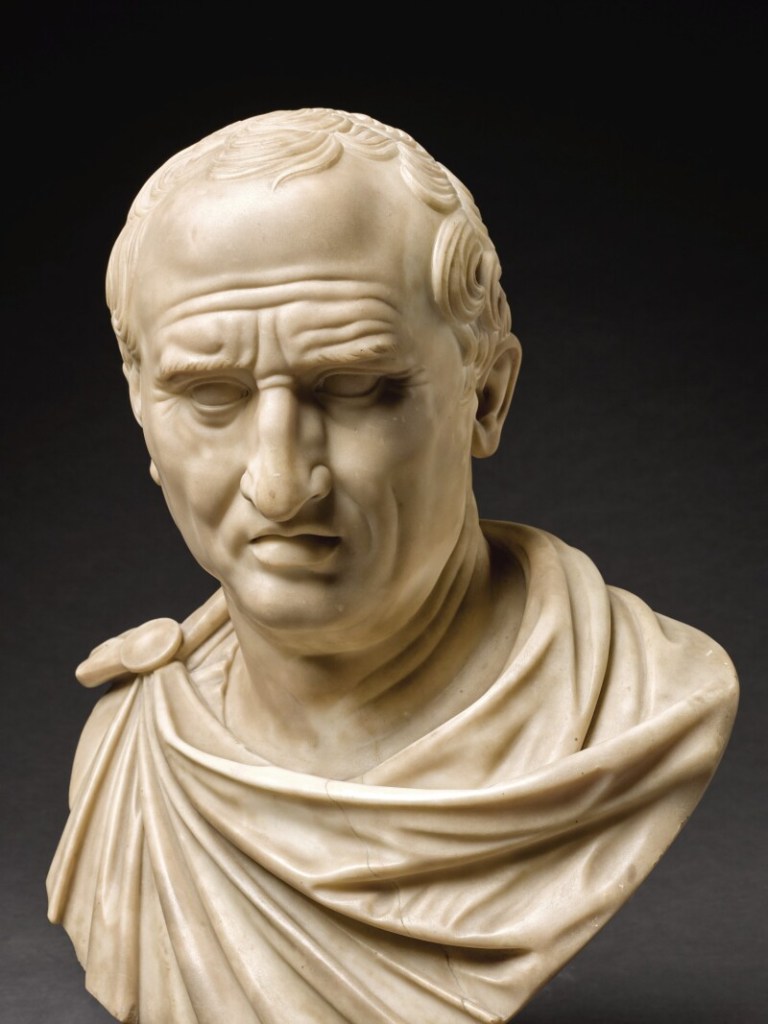
In the Tusculan Disputations, Cicero tells us that:
“From the quality of leadership (virtus), proceeds every honourable (honestus) activity, whether in volition, speech, or action, and all right rationality (recta ratio). Indeed, in the most concise formulation the quality of leadership (virtus) may itself be termed right rationality (recta ratio).” (Tusc. 4.34)
In this way, the quality of leadership becomes almost synonymous with right rationality (recta ratio). I would argue that while ratio is looking inwards at one’s own correctness, the quality of leadership must look outwards to one’s role in the social community. Virtus takes the inward understanding of right and wrong in ratio and mirrors it into the outward, making it social and moral. Cicero (and the Stoics) believed that these should be the same thing. Ratio and virtus are two sides of the same coin. They are both elements of a truth that is manifest both inwardly and outwardly. We should remember from our discussion on ratio that rationality is a function of nature and not the human intellect. Rationality is not about calculation. In the same way, the quality of leadership and the knowledge of what is morally right and wrong is not a matter of calculation. It is a matter of intuition and being in tune with nature (human nature included). Therefore, the quality of leadership looks to intuition and genuine connection to form and strengthen our relationships, not strategy and technique. This is transferable to all our social relationships, since every single one has a power dynamic.
If we want to be leaders, whether that at be leaders of our world, our community, our families, our friends, or even ourselves, it is this quality of leadership at which we must aim. At the same time, it is this quality of leadership which we must search for and expect in those in positions of power, from the smallest to the largest scale. In a healthy society, it is the quality of leadership which is most deserving of praise, and those who are most praiseworthy are raised to the positions of leadership and power. Over the next few weeks, we will focus on the quality of leadership and what it looks like. Drawing again from the Stoic philosophy, Cicero talks about four qualities of leadership (The 4 Stoic virtues); sapientia (wisdom), iustitia (justice), fortitudo (courage), and decorum (temperance). Each of these four qualities of leadership come with a duty or appropriate action (officium) that is owed to one’s political community. Next week, we will discuss Cicero’s use of the word officium. Then, over the following weeks with will discuss each quality of leadership in more detail to give us a fuller picture of how a healthy inward state with this quality of leadership manifests itself into honourable action and creates healthy social communities.


One response to “9. Virtus: The Quality of Leadership as a source of good action”
[…] week on responsible action (officium), we are now ready to look at the first quality of leadership (virtus), sapientia. This is the core quality on which the others are based. The Oxford Latin Dictionary […]
LikeLike