

After our discussion last week on responsible action (officium), we are now ready to look at the first quality of leadership (virtus), sapientia. This is the core quality on which the others are based. The Oxford Latin Dictionary defines sapientia as ‘soundness of mind’ or ‘wisdom’. I will use the word wisdom as the English equivalent of sapientia. Cicero tells us that wisdom is the quality of leadership which most closely relates to human nature. In fact, he claims that all humans feel a pull towards learning and have a desire to know. I do not think human nature has changed since then. We still have a natural pull towards learning and feel delight when we learn something new. Indeed, every human being should, by nature, want to be wise.
We will remember the wise man (sapiens) from our discussion on the emotions (perturbationes). He was someone who did not hold onto false beliefs and as a result was not agitated by restless emotions. He was someone in tune with nature and rationality (ratio). Rationality, we will remember, is not defined by human calculation, but by a natural order in the universe. In this way, wisdom can be understood as a knowledge of rationality. Therefore, it is important that we differentiate wisdom from intellect. Wisdom is concerned with the learning of what is true in nature. On the other hand, the intellect is concerned with thinking through complex problems and rationalising. Rationalisation is a human process that attempts to define what is rational with human calculation. More often than not, this puts a veil over true natural rationality. Therefore, someone who is intelligent, is not necessarily wise. Although intelligence directed in the right way, may help one become wise.

The root of sapientia will help us better understand the nature of wisdom. Sapientia comes from the verb sapio whichmeans ‘to taste’, or ‘to have good taste’. In his way, the wise man knows the ‘taste’ of true natural rationality and can recognise it in his experiences. A well-trained and experienced Sommelier has the taste and wisdom to recognise the many subtleties and notes in different wines that most people would miss entirely. A master chef does not need to follow a recipe word for word. Instead, he has the wisdom to be able to improvise. I used to watch Dr. Ian Dallas’ Chef and was always amazed with the way he worked in the kitchen. For example, when roasting chicken, he would not use a timer. Still, they were roasted to perfection every time. I asked him once how he was able to achieve this. His reply was that a timer does not always work because every chicken is different. Some need cooking longer than others. He has spent so long mastering his craft that he could just trust his instincts. There was no longer any thinking or calculation that was needed. This is what wisdom looks like, whether it is experienced in cooking or in any other art in life. Wisdom is not defined by our rational thought processes. It is based on intuition and how refined our taste for truth is.

Cicero mentions three responsible actions that are related to the quality of leadership, wisdom? First, he says it is important that we avoid assenting to things rashly, especially if we are not sure about them. Instead, one must take time and care when pondering matters. This reflects the importance of not holding onto the false beliefs which cause emotions. Instead, what is required is honesty about what we do not know. Second, he says that we must avoid excessive devotion and effort on matters that are abstruse, difficult and unnecessary. If some knowledge is not related to human nature or the vast experience of life and has no particular use, then what is the point of learning it? This leads us to the third responsible action. Cicero states that:
“It is irresponsible (contra officium) to allow such a devotion to draw us away from practical achievements. All praise that belongs to the quality of leadership (virtus) lies in action.” (Off. 1.19)
In this way, public service always comes before theoretical knowledge. Wisdom is only useful when it helps us to act. We should not avoid acting because of an obsession of being right. In fact, practical experience and taking counsel in such matters is often a much better teacher than the theory in books. Nevertheless, as Cicero goes onto remind us, there are often breaks in public life in which we can return to our studies and this is an honourable thing to do. Cicero only turned to philosophy when his ability to hold sway in the public arena diminished with the rise of Caesar. The writing of philosophy was the action he thought would best serve his community.
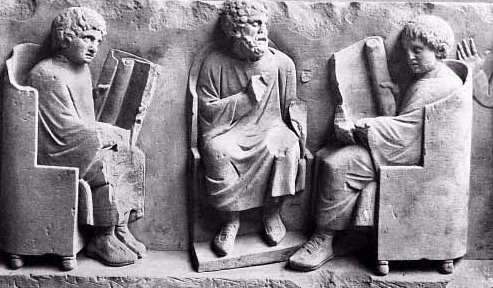
Wisdom is certainly an important quality for a leader. Without wisdom, how is one going to make the correct decisions that can benefit one’s community? As we have discussed, wisdom does not come from a rationalisation or complex problem solving. Instead, it is a quality of intuition and good taste. It grows as we do, and therefore we most often find wisdom in the older generations who have the experience and knowledge of an entire lifetime. So, to conclude, I would advise all you who are reading this to seek wisdom from the elders in your community, whether they be your parents, grandparents, teachers or otherwise. You do not need, nor should you, assent to their wisdom too quickly but ponder what they have to say. They might be able to teach you a lesson it took them an entire lifetime to learn.

 Via Ciceronis