


Last week we discussed the first of the four qualities of leadership, wisdom (sapientia). We found that wisdom was different to intellect and had little to do with one’s ability to rationalise or solve complex problems. Instead, it was a quality of intuition and good taste. Wisdom was the quality of leadership through which the others were defined. Of course, it is only through wisdom that we can understand the nature of ourselves and the world around us. Iustitia is another quality of leadership with an important role. In fact, Cicero argues that this is the most important quality of leadership. First, it is the quality of leadership that holds the bonds of human fellowship together, allowing us to be social and live together in a free society. Second, it limits the other qualities in the social arena. Accordingly, it is often referred to as ‘the social virtue’. The most common translation of iustitia is ‘justice’. I am tempted to use the word ‘fairness’ instead. The word ‘justice’ has connotations of a large institutional structure, a judicial system with written laws. The word ‘fairness’ would be able to avoid these institutional connotations and keep iustitia in the realm of human social interactions. However, it feels unnatural to me. Therefore, I will continue to use ‘justice’ as the equivalent of iustitia. Still, it is important that we remember that we are speaking about the human quality of justice, and not institutional justice.
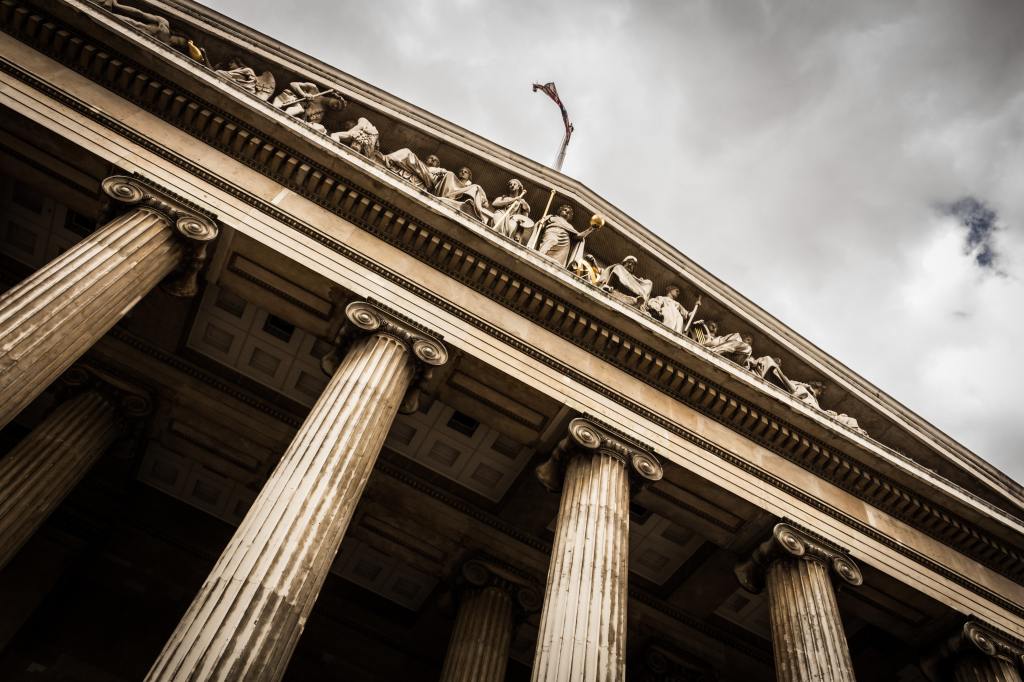
In De Officiis (On Responsible Action) we find the earliest theory that describes justice as that which builds up a society. Justice is the quality of leadership that maintains and builds trust (fides) between people and allows us to live in free social communities of whatever size. Without justice, there can be no trust. We trust people to treat us justly, and people trust us to treat them justly. When we are treated unjustly, we lose that sense of trust. If we think of society as a building, the people living together would be the bricks. Trust would be the cement that holds those bricks together. Trust is what binds us to one another. Without it, the building might be able to stand, but it would be very weak and prone to collapsing even with the slightest wind. Without justice, we would have no trust to bind people together in groups. We would not be able to build communities together, and existing ones would collapse. This is true on all scales from the personal to the global. It follows that the more justice there is, the stronger the trust and the bonds of human fellowship between people are, enabling us to accomplish more together.

What are the responsible actions related to justice? I will keep my focus on the first responsible action which is the most general and relevant for us. Cicero states that
“Of Justice (iustitia), the first duty (munus) is that no man should harm another unless he has been provoked by injury” (Off. 1.20)
This responsible action is rather self-explanatory when expressed in such simple terms. However, when Cicero turns his discussion to injustice and irresponsible actions, more is revealed:
“Of injustice (iniustitia), there are two types: men may inflict injury; or else, when it is being inflicted upon others, they may fail to deflect it, even though they could.” (Off. 1.23)
In this way, there are both passive and active responsible actions related to justice. Passively, one must not harm anyone. Actively, one must stop others from being harmed, if one can do so. Of course, this does not mean that we are required to step in and stop all injustice in the world. When we have the means though, it is unjust for us to stand by and do nothing. This is how justice acts as a limiting force on wisdom. If one has the wisdom to know how to enact change in the world, it would be unjust if one did not do so. As we saw last week, one of the responsible actions of wisdom was that we do not allow it to draw us away from practical achievement. It is unjust to abandon one’s social responsibility for one’s antisocial, and even selfish, desire for knowledge. To do so would not be wise since one would be breaking down society on which we all rely. Interestingly, Cicero tells us that most people act unjustly because of their emotions (perturbationes). People commit injustices either to secure something they desire for themselves, or because they fear that if they do not commit the injustice, they will be inflicted by some disadvantage. For example, people often turn a blind eye to unethical business practices to close a deal because of an unjust desire for money. Other people commit the same injustice, fearing that if they do not make the deal, then the competition might get the edge on them and put them out of business. In this way, we find that our discussion on the emotions takes on another significance. The emotions are not only averse to our own health, but the health of society as well. The emotions threaten the justice which holds the bonds of human fellowship together. Therefore, it is not only for our own health that we must work on the tranquillity and calmness of the inward state (animus), but for the health of our social communities as well.

I would recommend reading De Officiis 1.20-61 (This is only 15 pages) for a fuller discussion on the responsible actions associated with justice. Next week, we will move onto another aspect of justice, a positive justice which Cicero calls benignitas (kindness). Before we discuss benignitas, I want to leave you with an idea which, from this point on the Via Ciceronis, I think should be much clearer. It is the mirroring of the outward and inward experiences. In our discussion of the Ciceronian remedies (remedia), we spoke about the need to listen to our internal compasses. If we want to have healthy inward states, we need to trust ourselves and our instincts. After our discussion today on justice, we can better understand how to do this. If we want to build trust in ourselves, we must treat ourselves justly. We cannot treat ourselves harshly, nor allow ourselves to run riot. In this way, we see trust and justice as being vital for both inward psychology and outward politics. What we are seeing here is a mirror reflecting the outward on the inward and vice-versa. In this way, psychology can then be viewed as internal politics, and politics, as external psychology. They are the same thing on a micro and macro scale. We must keep this in mind, as we proceed. The concepts we are dealing with are not always the easiest to grasp. However, by changing the scale, either zooming in, or zooming out, things often become much clearer.

 Via Ciceronis
One response to “12. Iustitia: Justice and the Building Blocks of Society”
[…] week we discussed the second quality of leadership, justice (iustitia). We found that it was the responsibility of everyone to be just, both passively and actively. Not […]
LikeLike